An alternative reading of colonial photographs
To exhibit is not to display
When I first came across colonial photographs, the shock was such that I looked away. One scene in particular made my heart ache. Even now, I carry these images within me without quite knowing what to do with them, confronted by the sense of having seen something that no one should ever have to see. It felt as though no one should be forced to face such a display of violence, and that nothing could come of it except a profound disgust toward the photographer, who sees not horror but the “right” shot, turning the real suffering into a trophy. Out of respect for the men and women whom photography freezes into identities of colonized or condemned, erasing any previous trace of emotional or intellectual life, I lower my eyes. I refuse to scrutinize in detail flesh exposed against its will.

And yet, these images still circulate widely — notably in shops and specialized websites selling old photographs and postcards — they continue to exist in some people’s memory, embedding themselves in the retina through the shock they provoke. A shock so intense that it frequently blocks any form of reflection, favoring instead a strange fascination and an aestheticization of pain and domination. In her work Regarding the pain of others, Susan Sontag questions the impact that images of violence can still have in a world where every conflict is broadcast nearly instantaneously. Does the sheer volume of information enable us to reflect on what we see? Do we have the necessary distance? Do we even have time to obtain it? Or do we simply view these images in the numbing fatigue of habit and powerlessness, reducing victims of violence to recurring motifs, an inexorable datum of the world we inhabit?
“The only people who perhaps have the right to look at images of such extreme suffering are those who have the power to lessen it […] or those who may learn something from that suffering.”
(…)
From the vantage of learning, cultural institutions — particularly museums — seem called upon to think through these objects in order to present them to the public in a coherent, contextualized, and annotated corpus. Yet even within collections, the erasure of identity in colonial photographs is problematic. During a residency at the Ethnographic Museum in Stockholm, the artist-researcher Jacqueline Hoang Nguyen noticed that the photographic portrait of Nam Phương (1913‑1963), the last Empress of Vietnam, was catalogued simply as “Anonymous.” In France, the Musée du Quai Branly is filled with nineteenth- and early twentieth-century expedition and colonial photographs that over time and through transfers across institutions became anonymized. The museum teams have been actively working in recent years to remedy this, collaborating with researchers and curators from concerned countries — as evidenced by the recent Dakar–Djibouti mission exhibition (Musée du Quai Branly, 15 April – 14 September 2025) curated by Africa collection head Gaëlle Beaujean. This effort to identify the subjects of photographs aims to extract them from a dehumanizing status of secondary character (or mere curiosity object) and to recognize the individuals who fully participated in the expedition. This careful identification work is accompanied by deep reflection on the modes of exhibition.
Christine Barthe (Scientific Head of the Photographic Collections Unit at Musée du Quai Branly) refused to reproduce photographs of the serpent-dance ritual in Walpi in the Ouvrir l’album du monde exhibition (Louvre Abu Dhabi, 25 April – 13 July 2019) and its catalogue, in order to respect regulations established in 1913. This decision illustrates the possibility (if not the necessity) of a curatorial practice in which the voices of the photographed subjects — or their communities — challenge the sole authority of the operator over what is claimed as “his” photograph. The presence of the album, opened to another page than the ritual, together with written documents, enabled showing and thinking about the history of the rite other than by images taken covertly or contrary to consent. These initiatives contribute to rebalancing — or at least interrogating — the unequal relationships between viewer/viewed, colonizer/colonized, which impregnate the images and, often, their exhibition. In a subsequent version of the exhibition (Quai Branly, 3 April – 2 July 2023) and its catalogue, Christine Barthe reflects on conditions of photographic display by quoting Georges Didi-Huberman:
“And then there is the simple — and really malicious — question — the political question — of knowing who owns the images. We say: ‘Take a photograph.’ But what do we take, from whom do we take it exactly? Do we truly keep it? And should we not return it to whom it rightly belongs?”
If the museum is indeed a venue for exhibition, it is not a place for spectacle. Thus these exhibitions cannot proceed solely from the European vantage point; they call for other perspectives, other histories, to tell and present the content of ambivalent photographs in a more appropriate way.
To exhibit colonial photography thus demands a careful process of research and selection, lest one reproduce colonial dynamics. Hence certain photographs of extreme violence are set aside. For a long time I believed it was better to grant such images a right to rest — especially when they originate from societies that believe in spirits and ghosts. I still believe this. Those who were too exposed have a right to withdraw from our gaze. They may be preserved or buried in familiar places, shielded from curious or foreign eyes. It seems to me to be their right and that of their descendants. This does not, however, remove the documentary purpose of photography, which from a historical standpoint bears witness to French actions on colonized lands and the bodies that inhabited them. As both an instrument of communication, control, and pseudo‑scientific research, French photography in Indochina shaped an entire imaginative terrain serving the colonial enterprise, of which the figure of the Congaï remains tragically emblematic. What are we to do with these images, still marketed in the “erotic” category on specialist sites for old photographs? Should or can we exhibit them, risking that their stories be overshadowed by an almost nostalgic admiration for what some see as pure aesthetic or technical beauty? On the other hand, ignoring these images condemns to oblivion the history and identity of these women, and prevents acknowledgment of their suffering. Though we may want to shield them from further gaze, these photographs are so numerous that they end up being exploited in publications like Sexe, Race et Colonies without any filtering or sufficient explanations to allow proper understanding. The brutality of that work — containing 1,200 explicit photographs of sexual violence, lacking rigorous research and analysis on the corpus — has been criticized by several scholars. Its appearance as an art book, with a black cover and neon-blue title evoking the doorway of a brothel opening into intimate views, reveals much about how its authors and publishers perceive these images. By reproducing them en masse in a beautiful object, designed to be seen rather than read, they relegate these photographs to the genre of erotic photography, releasing them from any notion of violence or history.
Artists as guardians of memory
We have needed artists such as Flora Nguyen (born 1975, Paris) to look at the images reproduced in Sexe, Race et Colonies with discernment. From a selection of photographs, the artist produces a series of painted or drawn reinterpretations. This transfer from photography to painting or drawing allows evocation of the subjects’ history without re-exposing them to a multitude of gazes. The finger that pressed the shutter is replaced by the hand that works, touches, and cares in color. In her watercolor Ophélie at War, she reworks Steven Curtis’s photograph The Enemy (Vietnam) (1968). With the intention of reversing the dehumanization of the photographed woman, the artist recolors the victim, restoring to her a coherent, tangible human presence, while the soldiers’ features, deliberately blurred, seem to denote their lack of humanity. The work of this Vietnamese‑origin photographic artist aims both at rehabilitating memory of women and children victimized by sexual crimes, and at deconstructing the images of a wild, lascivious Indochina with which colonized women were associated.
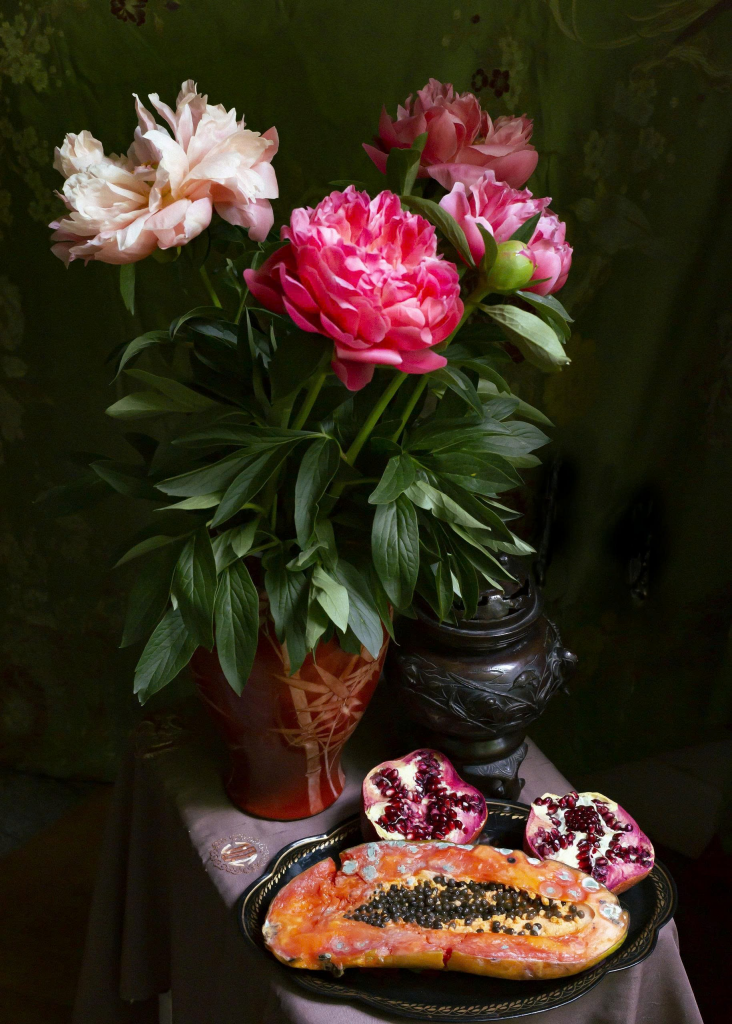
In her Love me tender series, Flora Nguyen reveals the fictional nature of colonial photographic compositions by mimicking them. In self-portraits, she poses within staged settings that provoke unease. Something is off in these settings, where disjointed and anachronistic elements mingle: incomplete traditional garments (sometimes Vietnamese, sometimes Algerian), Asian objects from various origins, glittering ballet flats. This accumulation of dissonant elements highlights the photographic construction of a fantasized colony. In the same series, her still-life compositions both intrigue and disturb. As a symbol of exoticism par excellence, the papaya — like the Eden the colonists promised — decomposes on the table. The fruit rots, its orange flesh covered with grayish mold… The almost perceivable odor rouses the nostalgic dreamer. End of an illusion, obsolescence of a dreamed Indochina, or symbol of the consequences of colonial violence on the land? Perhaps a bit of both. In a black-and-white self-portrait, the artist poses with a papaya placed in front of her lower abdomen. Without having to re‑expose the photographed women, Flora Nguyen symbolizes the laid-bare flesh and its reification. The colonized woman, turned into commodity, is presented only through the lens of sexuality. Flesh and territory to be conquered until dispossessed. By masking her face in the photograph, the artist seems to suggest that identity counted little or not at all — the women pictured were interchangeable. A propaganda object by desire: many were subjected to the lens and all watchers. Yet today, they are among the great forgotten.
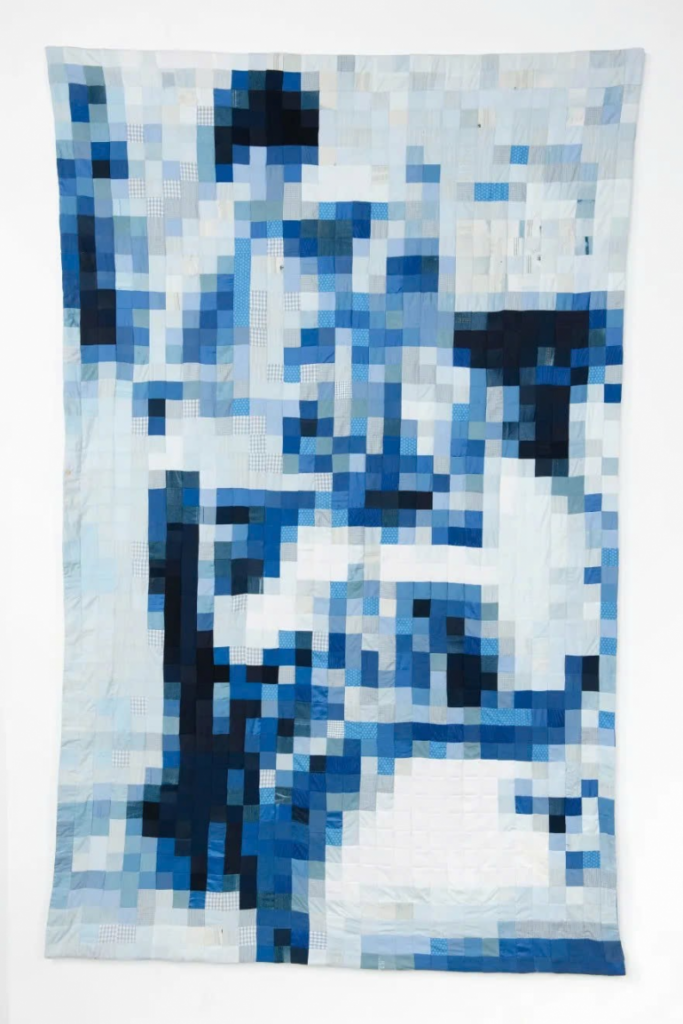
In the works of Vo Tran Chau (born 1986, Bình Thuận, Vietnam), the memory of the colonial era fades. Her patchworks of recycled fabrics integrate old photographs and postcards which, through weaving, appear to disintegrate pixel by pixel. With consistent viewing, one discerns streets, buses, old buildings, and nude female bodies. The titles “It was someone’s home”, “Once upon the time” “Where is the beginning”, “Where is the end” evoke empty places, incomplete or lost stories that we struggle to grasp. The images dissolve and harmonize into color pantones — “blue,” “green,” … Soon, the photographic subject becomes merely a blank, uniform surface, devoid of contours by which to identify the figure. Through fabric, the artist evokes memory that veils itself — a deposition of time that dims recollection. Will younger generations know how to read old photographs? Will they learn anything from them? I believe it is precisely the disturbed appearance of these textile reconstructions that prompts a work of reflection on the past. The blur forces us to look differently; by concealing shocking details, it allows the photograph to be apprehended in its totality: its context, its subject(s), its making, its reception. Made of fabric, flesh is signified rather than exposed; it speaks without betraying either the memory or the modesty of the photographed. The squares of fabric assembled may be viewed without ambiguity. Thus, the unshowable might be displayed: partially, and on condition of reflection.
To cover in order to better reveal
This is a plastic strategy also used by artist Manon Ficuciello (born 1991, Nice, France), who integrates tracing paper, photographs, and bandages into protean works where justice and care are central. Partial view of the cataract is constructed like a sick eye, whose white frame defines a vision progressively narrowed by pink ribbons and moist bánh tráng. At its center, red and blue threads mimicking blood vessels reveal the portrait of a girl, which they stretch on either side. Imprisoned in a gaze that turned her into fantasy, the Congaï resurfaces when the memory of Indochina is invoked. However, a photograph of a tuna steak — taken by the artist and enlarged on tracing paper — is superimposed over the girl’s nude body. While this addition aims to cover a body revealed without consent, it also signifies commercialization: like the tuna steak — fished, butchered, wrapped, labeled and sold across the world for its flesh — the young girl has been the object of an industrial practice of erotic postcards. Scrutinized, photographed, printed and stamped, she has been sent across seas to be consumed. Flesh exposed on paper.

In a performance titled Théaplastie, Manon Ficuciello questions the mythification and aestheticization of colonial violence, of which photographs of eroticized children are a result. In a historico-poetic text drawn from her research, the artist addresses the history and origins of colonization as images scroll by: representations of Alexandre de Rhodes, early Christian martyrs in Vietnam, seventeenth-century world maps, colonial archives… Together, images and texts reconstruct the genesis of a fantasized Indochina, a new Eden from which phantasmagoric figures like the Congaï emerged — the video and text concluding on her figure. On the original postcard — displayed on a lectern facing the public — the artist makes a final gesture of care. With gauze and bandages, she covers the naked body and raises it toward the heights, placing it on a makeshift ancestral altar, before performing a prayer. Bandaged, nearly embalmed, the photographed girl departs the realm of fantasy and enters that of ghosts. Her body on paper is laid to rest; her memory is prayed. Concerned with the fate of Congaï photographs, Manon Ficuciello scours sites selling old photographs to acquire them. One by one, those photographs become the subject of a unique performance, after which they are placed — always wrapped — on the artist’s ancestral altar, honored and prayed over out of view.
Art as place of burial
To learn, or to soothe. These ought to be our intentions toward photographs of suffering. Yet the bodies of work are too dense, the violence too intense, for all of us to confront them with assurance that we can make something productive of it. Usually, suffering leaps to our eyes and we do nothing. We fit ourselves with blinkers, we step back, relegating the imprint of shock these images provoked to the depths of our memories. A cultural institution must at least pierce the surface of the image, acknowledge its content, and explain it to the community. But the mitigation of pain, the understanding of an image in its most intimate and profound strata — I believe — can belong only to the artists. They alone seem granted the power to recognize and soothe in one gesture. A symbolic task, often near a religious ritual: Flora Nguyen evokes a tendency to repeat a shocking motif until exhaustion, the feeling that one has exorcised any trace of pain from the reference photograph. For the photograph contains violence, locks it in, and replays it for whoever chooses to look. Through the plastic gesture of mending, reworking, or covering, Manon Ficuciello, Vo Tran Chau and Flora Nguyen free the subjects of these images. They extract the soul and bring it to a safe place. The work becomes a place of burial where the photograph — like a damaged body — finally finds rest. A form worthy of being listened to and honored.
—
Éléonore Hải Vân Tran
References
- BARTHE, Christine. Opening the Album of the World: Photographs 1842–1896 [exhibition, Louvre Abu Dhabi, 25 April – 13 July 2019]. Abu Dhabi, Paris, Beirut: Louvre Museum, Musée du Quai Branly–Jacques Chirac, KAPH, 2019.
- BARTHE, Christine and LACOUR, Annabelle. Photographic Worlds: Early Histories [exhibition, Paris, Musée du Quai Branly–Jacques Chirac, Tuesday 4 April – Sunday 2 July 2023]. Paris: Musée du Quai Branly–Jacques Chirac, Actes Sud, 2023.
- FOURCHARD, Laurent. “On the Pitfalls of a Memorial Enterprise: P. Blanchard, N. Bancel, G. Boetsch, D. Thomas and C. Taraud (eds.), Sex, Race and Colonies: The Domination of Bodies from the 15th Century to the Present, Paris, La Découverte, 2018, 544 pages.” Politique africaine, 2018/4, no. 152, pp. 165–175. Published online 12 April 2019, accessed 9 September 2025. URL: shs.cairn.info/revue-politique-africaine-2018-4-page-165?lang=fr
- MAINE, Christine, LOCATELLI, Aurélien, JOLLY, Éric, LEMAIRE, Marianne, MALÉ, Salia, BEAUJEAN, Gaëlle, and KASARHÉROU, Emmanuel. Dakar-Djibouti Mission 1931–1933: Counter-Investigations [exhibition, Paris, Musée du Quai Branly, 15 April – 14 September 2025]. Paris, Madrid: Musée du Quai Branly–Jacques Chirac, Éditions El Viso, 2025.
- SONTAG, Susan. Regarding the Pain of Others. Paris: Christian Bourgois éditeur, 2022.
- TRACOL-HUYNH, Isabelle. “Prostitution in Colonial Tonkin: Between Race and Gender.” Genre, sexualité & société [online], no. 2, Autumn 2009. Published online 16 January 2010, accessed 9 September 2025. URL: http://journals.openedition.org/gss/1219
Notes
[1] SONTAG, Susan. Regarding the Pain of Others. Paris: Christian Bourgois éditeur, 2022, p. 45.
[2] Regulations enacted following initiatives by Leo Crane, Indian superintendent at Walpi. See: BARTHE, Christine, “Transporting Time, Transposing Space,” in BARTHE, Christine. Opening the album of the world: Photographs 1842–1896. Abu Dhabi, Paris, Beirut: Louvre Museum, Musée du Quai Branly–Jacques Chirac, KAPH, 2019, p. 26.
[3] DIDI-HUBERMAN, Georges, “Returning an image,” in ALLOA, Emmanuel (ed.), Thinking the image, Les Presses du réel, Dijon, 2010, p. 267.
[4] DE SAINT-OURS, Édouard and NGUYỄN, Jacqueline Hoàng, “At the crossroads of empires: early uses of photography in Vietnam,” in BARTHE, Christine and LACOUR, Annabelle. Photographic worlds: early histories, Paris: Musée du Quai Branly–Jacques Chirac, Actes Sud, 2023, p. 229.
[5] TRACOL-HUYNH, Isabelle. “Prostitution in colonial Tonkin: between Race and Gender.” Genre, sexualité & société [online], no. 2, Autumn 2009. Published online 16 January 2010, accessed 9 September 2025. URL: http://journals.openedition.org/gss/1219
[6] P. Blanchard, N. Bancel, G. Boetsch, D. Thomas and C. Taraud (eds.), Sex, Race and Colonies: The domination of bodies from the 15th century to the present, Paris: La Découverte, 2018.[7] FOURCHARD, Laurent. “On the pitfalls of a memorial enterprise: P. Blanchard, N. Bancel, G. Boetsch, D. Thomas and C. Taraud (eds.), Sex, Race and Colonies: The domination of bodies from the 15th century to the present, Paris: La Découverte, 2018, 544 pages.” Politique africaine, 2018/4, no. 152, pp. 165–175. Published online 12 April 2019, accessed 9 September 2025. URL: shs.cairn.info/revue-politique-africaine-2018-4-page-165?lang=fr
WRITER
ELEONORE TRAN